

As this is the final biography I'll be writing, it's only fitting that I try to squeeze as much in as I possibly can. The first "and many more..." was the 51st page that I did, so I guess it's synchronistic that this second one is the 101st.
While our catalogs feature many elegant and expensive books by very famous illustrators, that's not all that you'll find therein. Both Bud and I love and collect the work of hundreds of not-so-famous artists. These men and women are analogous to the character actors who support the star performers. Their work is strong and colorful and much more accessible than that of the major illustrative stars. Here's a trio that I collect and enjoy.

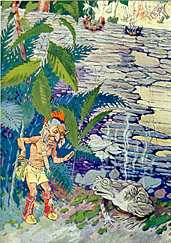
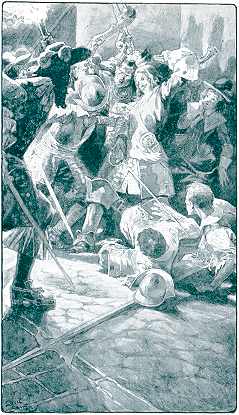 Will
Crawford was born in 1869 in Washington, DC, and grew up with
the pen. He started out young as a newspaper artist and cartoonist
while still in his teens and was more than comfortable with paint
and wash. The illustration at right is from the 1901 book that
he illustrated, When the Land Was Young.
Will
Crawford was born in 1869 in Washington, DC, and grew up with
the pen. He started out young as a newspaper artist and cartoonist
while still in his teens and was more than comfortable with paint
and wash. The illustration at right is from the 1901 book that
he illustrated, When the Land Was Young.
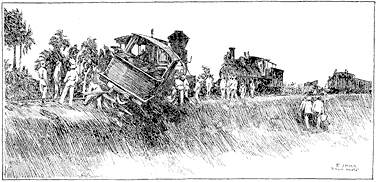
It was in the realm of pen and ink that Crawford proved to be the most comfortable and innovative. In his illustrations, as opposed to his cartoons, he eschewed the use of the confining outline. His drawings were swimming with light built laboriously from black pen strokes. As contradictory as that sounds, he brought it off in a manner most impressive and refined the technique throughout his career.
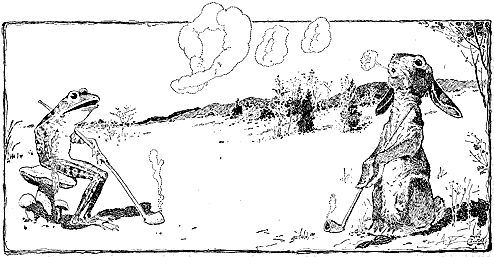
That career involved humor illustrations for such magazines as Puck and Life (1899 example above) as well as illustrations for humorous stories in the major magazines of the day: The Century, Everybody's, McClure's, Scribner's, Leslie's and Redbook.
Some drawings were more successful than others. Occasionally, his efforts at conveying mass and form by way of fine stipple and varying line weight were thwarted by the limitations of the printing press. It's a tribute to his vision that these near misses don't suffer from being too dark, but from being too light! Fortunately as time passed, the improvements in printing allowed him full realization of that vision.
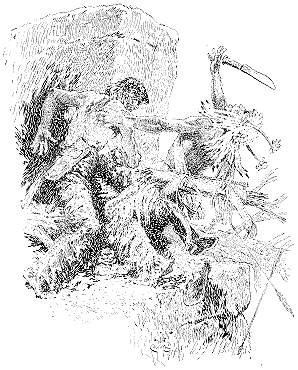
Below is an illustration from Greenhorn's Hunt from 1934. Printed on slick paper with more modern equipment, the illustrations in this book are perfect examples of his mature style. Click on the image below to get a close-up look at his amazing technique.
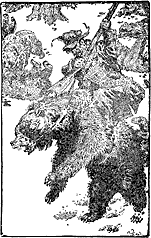
 Another
good example of this style, though printed on more porous paper,
is the work he did in 1926 for Paul Bunyan and His Great Blue
Ox (at left). As with most pen & ink techniques, the internet
provides a very poor medium for reproducing this type of art.
A much more advantageous presentation of his work can be found
in Fred Taraba's The Flamboyant Pen of Will Crawford
in Step-By-Step Graphics Vol. 16, #4 (July/August, 2000).
Another
good example of this style, though printed on more porous paper,
is the work he did in 1926 for Paul Bunyan and His Great Blue
Ox (at left). As with most pen & ink techniques, the internet
provides a very poor medium for reproducing this type of art.
A much more advantageous presentation of his work can be found
in Fred Taraba's The Flamboyant Pen of Will Crawford
in Step-By-Step Graphics Vol. 16, #4 (July/August, 2000).
Also in 1926, he illustrated Skunny Wundy and Other Indian Tales with b&w line art and tipped-in color plates - which was not a common practice of the day. This book and its 1928 follow-up, Rumbling Wings and Other Indian Tales, were perfect vehicles for Crawford's humorous animals. These were easily comparable to T.S. Sullivant and Harry Rountree. In many cases, however, the reproductive techniques were simply not up to the task of presenting such refined lines.
Crawford died in 1944.

 First Annual Collection |

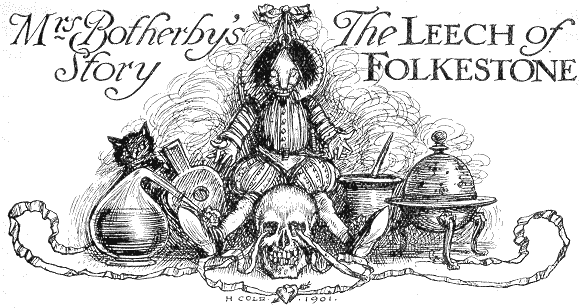
 Born
in England in 1867, Herbert Cole is one of the many journeyman
artists who answered the call of the illustrated magazines of
the late 19th century. He was a prolific artist about whom little
is known. He worked in British magazines in the 1890's. Some of
his earliest book illustration was for a John Lane edition of
Gulliver's Travels in 1900. The influence of E.J. Sullivan is strong, as seen below, but
his clever and innovative designs are uniquely his own.
Born
in England in 1867, Herbert Cole is one of the many journeyman
artists who answered the call of the illustrated magazines of
the late 19th century. He was a prolific artist about whom little
is known. He worked in British magazines in the 1890's. Some of
his earliest book illustration was for a John Lane edition of
Gulliver's Travels in 1900. The influence of E.J. Sullivan is strong, as seen below, but
his clever and innovative designs are uniquely his own.
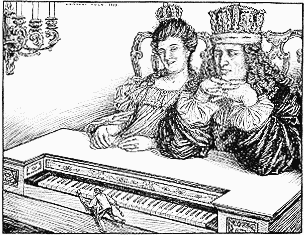
His 1903 edition of The Ingoldsby Legends was profusely illustrated and featured unusual compositions such as the chapter head below. Perhaps a bit of Sullivan's fascination for skeletons also rubbed off on Cole.
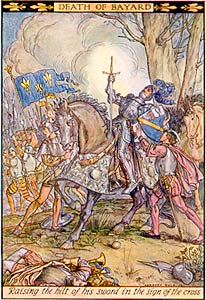
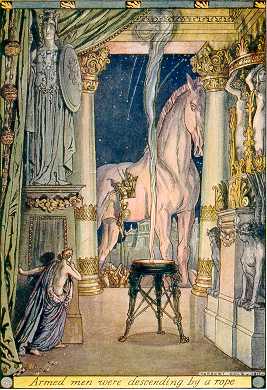 A
set of books from 1911, The Story of Bayard (top left)
and The Sunset of the Heroes (right) displayed an awareness
of and fondness for the work of Walter Crane a generation earlier.
Considering that these were being published simultaneously with
Rackham and
Parrish and
Dulac and Pogany, it becomes apparent
that along with the artists, the publishers were searching for
a style.
A
set of books from 1911, The Story of Bayard (top left)
and The Sunset of the Heroes (right) displayed an awareness
of and fondness for the work of Walter Crane a generation earlier.
Considering that these were being published simultaneously with
Rackham and
Parrish and
Dulac and Pogany, it becomes apparent
that along with the artists, the publishers were searching for
a style.
I've only seen one later book illustrated by Cole and that
was in 1926. He died in 1930.

 Everett
Shinn is another of those artists whose pen & ink and color
work are shifting favorites. Shinn, born in 1876, had a long and
varied and illustrious career. He was, at various and often concurrent
times, an illustrator for magazines like Harper's, McClure's,
Look, Judge, Life, etc., a noted painter
of New York street life (part of The Eight or The
Ashcan School of the early 20th century), an interior
decorator of sorts, a muralist, a painter of theater and circus
scenes, and a book illustrator. You can read all about his fascinating
life in Everett Shinn 1876-1953 A Figure in His Time@,
by Edith de Shazo. I'm going to focus here on his illustrations.
Everett
Shinn is another of those artists whose pen & ink and color
work are shifting favorites. Shinn, born in 1876, had a long and
varied and illustrious career. He was, at various and often concurrent
times, an illustrator for magazines like Harper's, McClure's,
Look, Judge, Life, etc., a noted painter
of New York street life (part of The Eight or The
Ashcan School of the early 20th century), an interior
decorator of sorts, a muralist, a painter of theater and circus
scenes, and a book illustrator. You can read all about his fascinating
life in Everett Shinn 1876-1953 A Figure in His Time@,
by Edith de Shazo. I'm going to focus here on his illustrations.
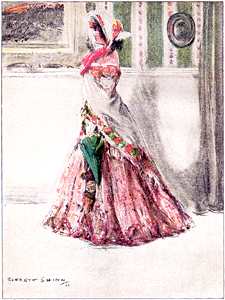 Above
left is a drawing from McClure's Magazine for June 1898.
Drawn by Shinn after a photograph, it is one of the earliest works
I've seen by him. The vast majority of the material he did prior
to this was for newspapers. They are most ephemeral and scarce.
At right is the frontispiece for Barbara Frietchie, a book
from 1900. But it's not until 1938 that Shinn as book illustrator
really emerges.
Above
left is a drawing from McClure's Magazine for June 1898.
Drawn by Shinn after a photograph, it is one of the earliest works
I've seen by him. The vast majority of the material he did prior
to this was for newspapers. They are most ephemeral and scarce.
At right is the frontispiece for Barbara Frietchie, a book
from 1900. But it's not until 1938 that Shinn as book illustrator
really emerges.
 In
a wonderful series of books published by John C. Winston and Garden
City Publishing Co., Shinn brought his considerable talents to
such commercial titles as Dickens' A Christmas Carol and
Christmas in Dickens, Poems of Childhood, The
Happy Prince, Rip Van Winkle, The Life of Our Lord@ and other religious titles. The
books were all profusely illustrated with shimmering color plates
and exquisite pen drawings. There must be a dozen titles in all,
and each is a special joy with lush color endpapers and finely-wrought
pen work in addition to the nicely-printed color plates. They
represent what I consider to be a high point in his career. Yet
they are not even mentioned in A Figure in His Time!
Go figure...
In
a wonderful series of books published by John C. Winston and Garden
City Publishing Co., Shinn brought his considerable talents to
such commercial titles as Dickens' A Christmas Carol and
Christmas in Dickens, Poems of Childhood, The
Happy Prince, Rip Van Winkle, The Life of Our Lord@ and other religious titles. The
books were all profusely illustrated with shimmering color plates
and exquisite pen drawings. There must be a dozen titles in all,
and each is a special joy with lush color endpapers and finely-wrought
pen work in addition to the nicely-printed color plates. They
represent what I consider to be a high point in his career. Yet
they are not even mentioned in A Figure in His Time!
Go figure...
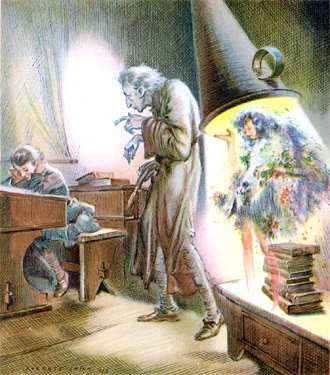
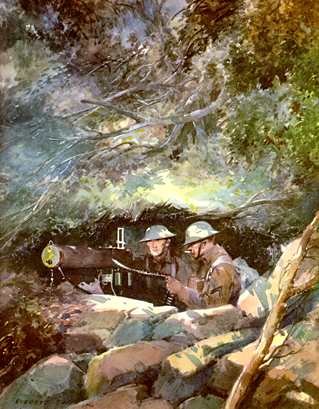
Above left (in green) is one of the marginal drawings from Rip Van Winkle (1939) and directly above is a depiction of Scrooge from A Christmas Carol (1938). And below is one of the six full-page plates he did for a book called The United States Army in 1941. Like I said, you can read all about the rest of his life in de Shazo's book, but this wonderful later work is only documented here. I think it resonates of illustrator/artist prejudice, don't you?
A great line from James Montgomery Flagg on the Illustrator/Artist debate: "The difference between the two is that the former knows how to draw, eats three square meals a day and can pay for them."
I hope you will continue to get enjoyment from the other 100 biographies I've written. More and more detailed pictures from your favorite artists will also be featured in "The Vadeboncoeur Collection of ImageS" - a new magazine I've created to bring new life to these classic illustrations. If you're interested in the reasons for my "retirement," please click here.



| Everett Shinn 1876-1953 A Figure in His Time | Edith de Shazo, Clarkson N. Potter, 1974 |
| 200 Years of American Illustration | Henry C. Pitz, Random House 1977 |
| The Dictionary of British Book Illustrators and Caricaturists 1800-1914 | Simon Houfe, Antique Collectors' Club 1978 |
| The Flamboyant Pen of Will Crawford in Black & White Images - First Annual Collection | Fred Taraba, Jim Vadeboncoeur, Jr. Publishing 2002 |
| The Vadeboncoeur Collection of Knowledge | Jim Vadeboncoeur, Jr. 2001 |
| Illustrations are copyright by their respective owners. This page written, designed & © 2001 by Jim Vadeboncoeur, Jr. |


 |
|
 |